AI visibility tool: how to track your brand in ChatGPT, Gemini and Perplexity

AI summary
- AI visibility shows how often ChatGPT, Gemini, Claude, Perplexity and Google's AI Overviews mention your brand, link to your site and describe it.
- In a client project the shop appeared in almost every branded question and barely in generic ones, which are the questions new customers ask.
- A useful tool runs fixed prompts across several models with repetitions, counts mentions and links separately and shows your share of voice against competitors.
- Social listening tools such as Brandwatch track conversations on the web and leave AI answers out, so you need a dedicated AI visibility tool for that.
Created with AI, the details are in the article.
Table of contents
- What is AI visibility?
- Our own analysis: demand for AI visibility tracking in the US
- Which AI systems should you track: ChatGPT, Gemini, Claude or Perplexity?
- How to track AI visibility step by step
- Best visibility tools for AI search in 2026: three types of platform
- How to choose the best AI visibility tool
- How to improve your visibility in AI answers
- AI visibility as a KPI: how to justify the ROI to your CMO
- FAQ
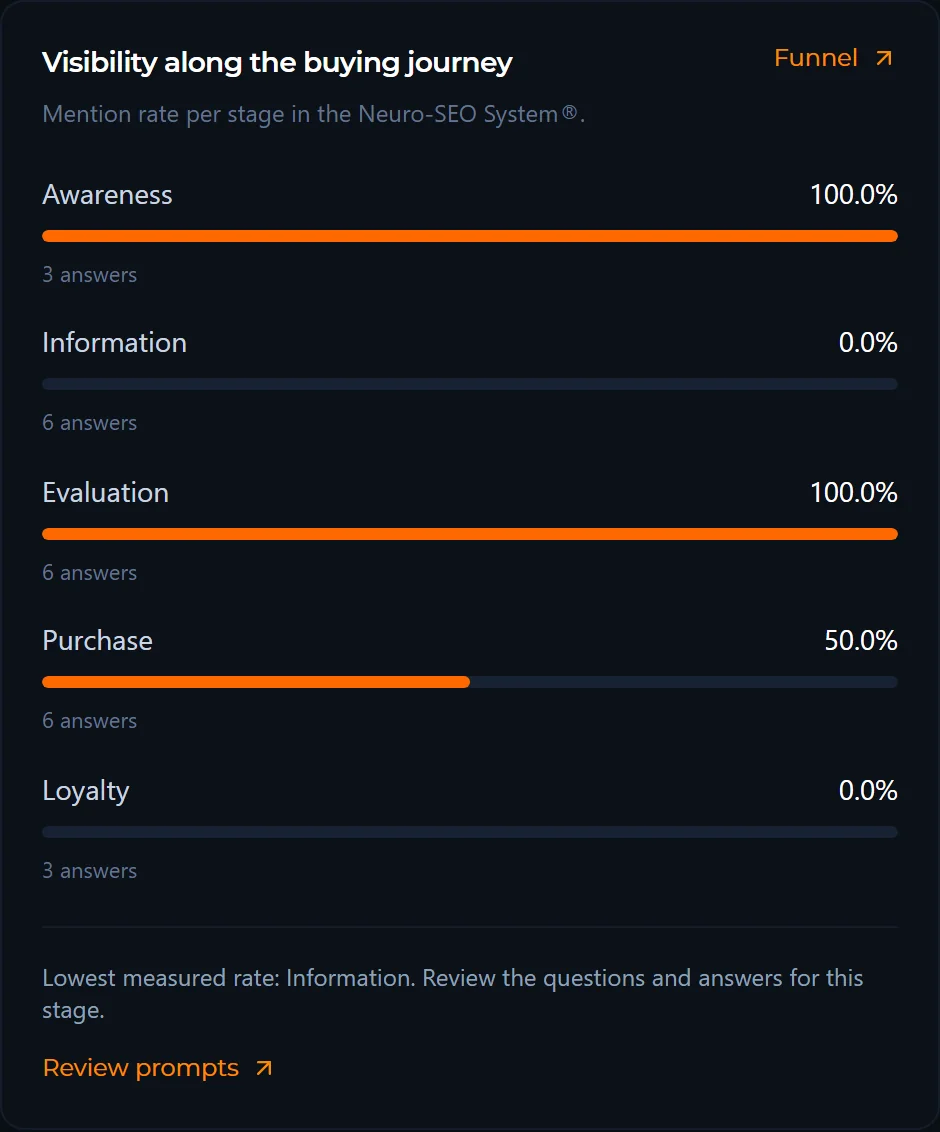
A short case study from a client project: in autumn 2026 I measured for the first time how often ChatGPT, Gemini and Claude mention an online shop I work with. The result was clear. For questions that contained the brand name, the shop showed up almost every time. For generic questions without the brand, it barely appeared. That is exactly where new customers search. The team had no idea, because none of their usual metrics show this gap.
That gap is what an AI visibility tool is for. In this article I explain what AI visibility means, which metrics matter, how to track AI visibility properly and what to look for when you choose a tool. I use the workflows from my own client projects and show them in Visibly AI®.
What is AI visibility?
AI visibility describes how often and in which context a brand appears in AI answers. That covers ChatGPT, Gemini, Claude, Perplexity and the AI Overviews in Google. Three things get measured: Is the brand named in the answer text? Is your website linked as a source? And how does the answer describe the brand?
How does visibility in generative AI and AI Overviews work?
Behind these systems is artificial intelligence, more precisely generative AI. Large language models write their own text from many sources. For research, they replace the ten blue links people used to click through themselves. Google's AI Overviews work in a similar way: a summary sits above the search results, with linked sources. You are visible if you are named in that text or linked as a source.
AI visibility vs. SEO visibility
In classic search engine optimization you count rankings and clicks. Google's algorithms sort a list of links. A language model delivers a finished text instead. Your brand is in it, or it is not. Good rankings help, because many AI systems pull their sources live from the web. They do not guarantee a mention, because the AI algorithms choose from those sources by their own rules.
"Good rankings do not guarantee visibility in AI answers. And poor rankings do not rule it out," says Antonio Blago, SEO expert and founder of Visibly AI®.
What does an AI visibility tool actually track?
| Metric | What it shows | How it is measured |
|---|---|---|
| Mention rate | Share of answers that name the brand in the text | Mentions divided by all queries in a run |
| Citation rate | How often your website is linked as a source | Queries with a link divided by all queries |
| Share of voice | Your share of all brand mentions compared with competitors | Own mentions divided by all brand mentions |
| Position | Whether you are the first recommendation or named last | Order of the brands named |
| Sentiment | Whether the AI describes the brand positively, neutrally or critically | Rating of tone and aspects per mention |
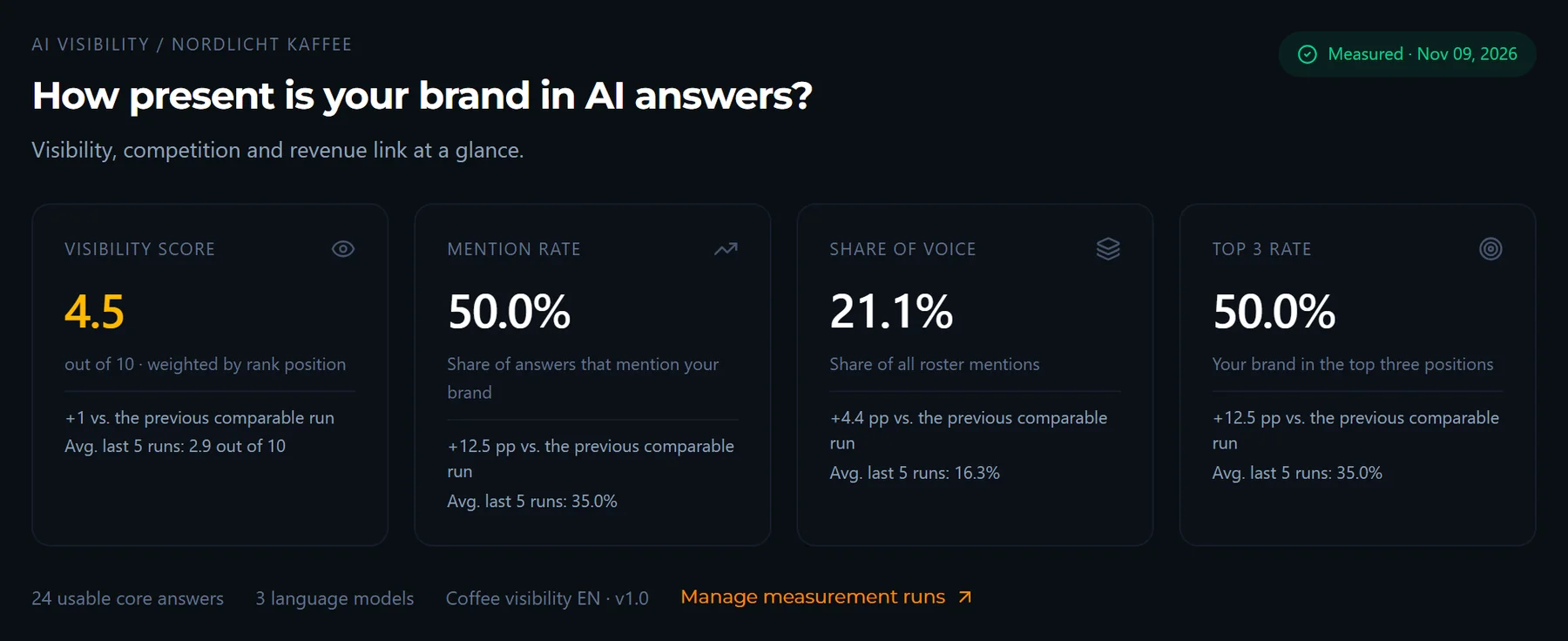
Keeping mentions and links apart matters. If a brand only appears in a source list, the user never read it in the answer. Visibly counts both separately.

Our own analysis: demand for AI visibility tracking in the US
This is our own original research: for this article I collected our own data with Visibly AI® (search volumes for the United States, as of 9 November 2026). Interest in tracking AI visibility is no longer a niche:
| Search query | Monthly searches (US) |
|---|---|
| ai visibility tool | 880 |
| ai visibility tracking | 320 |
| llm visibility | 260 |
| llm seo tools | 210 |
| ai brand monitoring | 170 |
| llm visibility tracking | 140 |
| how to rank in chatgpt | 140 |
Most of these searches come from people who already know the problem and look for a way to measure it. That matches what I see in projects: users get their answer straight from the chat or the AI Overview, click less and make their shortlist earlier. Part of the traffic moves in front of your own website.
Which AI systems should you track: ChatGPT, Gemini, Claude or Perplexity?
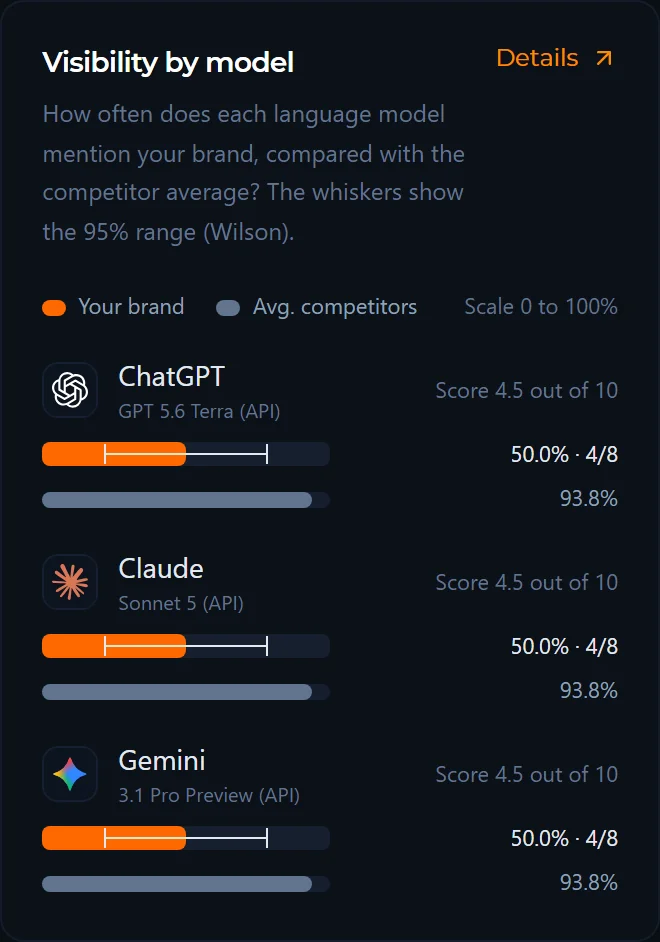
For most companies ChatGPT, Gemini, Claude and Perplexity are enough, plus the AI Overviews in Google Search. The systems differ a lot. Some answer from training data. Others search the web live and name completely different vendors and sources. A single prompt in ChatGPT therefore tells you little. The results change a bit with every repetition.
B2B and B2C: who benefits most?
Brands with products that need explanation benefit most: B2B companies, SaaS and online shops with advice-heavy products. Buyers ask the AI long questions and let it recommend vendors. In B2B marketing, decision makers often build their shortlist in the chat before they visit a website. In B2C, questions are shorter and more price-driven. Comparison sites and reviews matter more, and large retailers often come first in AI answers.
How to track AI visibility step by step
Many teams start by typing a few prompts into ChatGPT by hand. That gives a first impression, but it is not tracking. To track AI visibility you need fixed prompts, several models, repetitions and a competitor comparison. This is how I set it up in projects:
- Build a prompt set: 30 to 100 questions the way real buyers ask them. In Visibly you assign each prompt to a persona, a topic and a stage of the buyer journey. Control prompts with your brand name show whether the models know you at all.
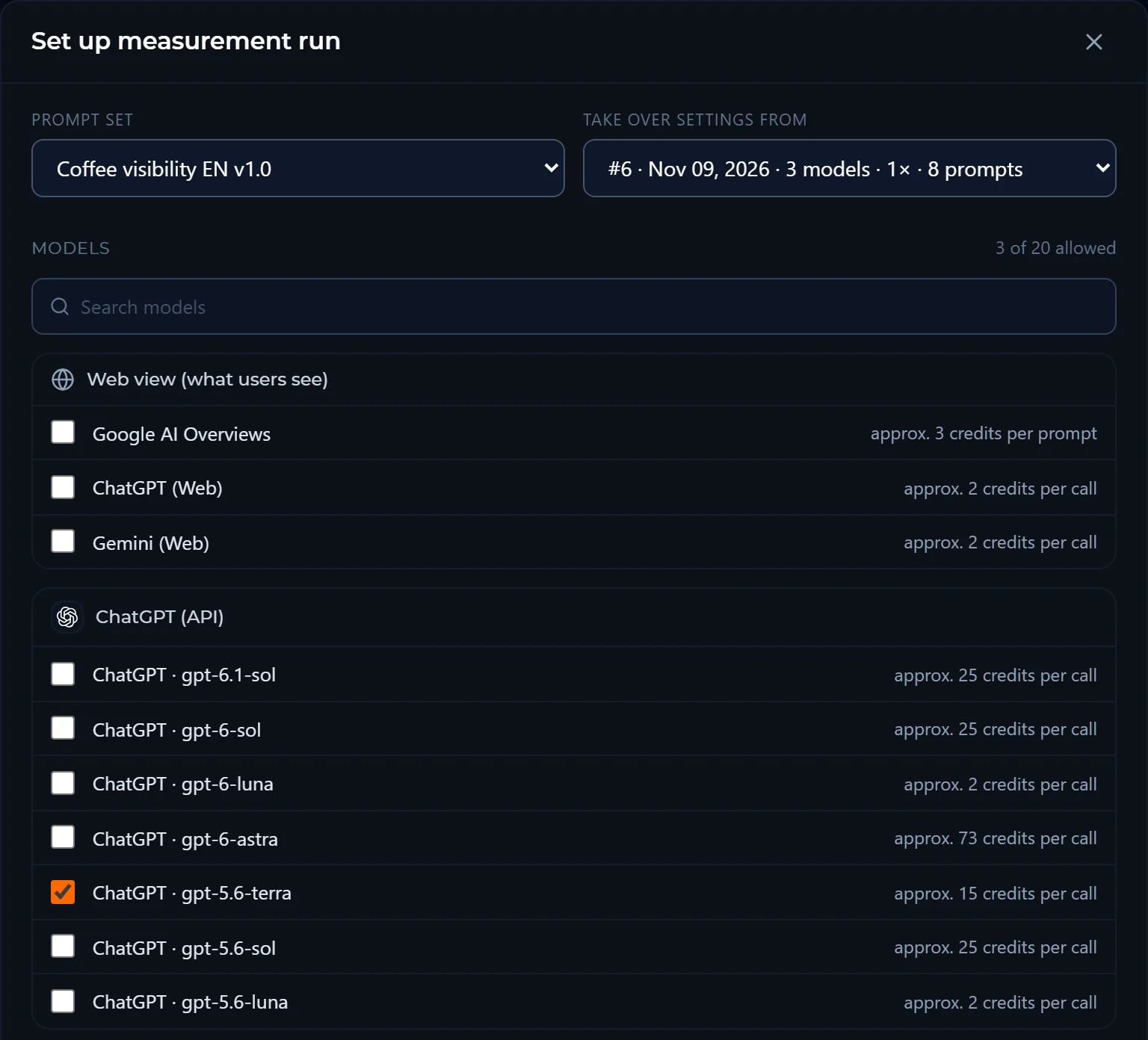
- Choose the models: In LLM Visibility you pick models from ChatGPT, Claude, Gemini and Perplexity. The web view of ChatGPT and Gemini shows what users really see in the interface, including web search. Visibly also checks whether Google shows an AI Overview and whether your domain is linked in it.
- Run with repetitions: Visibly measures how stable the answers are across repetitions, so you can tell real change from noise.
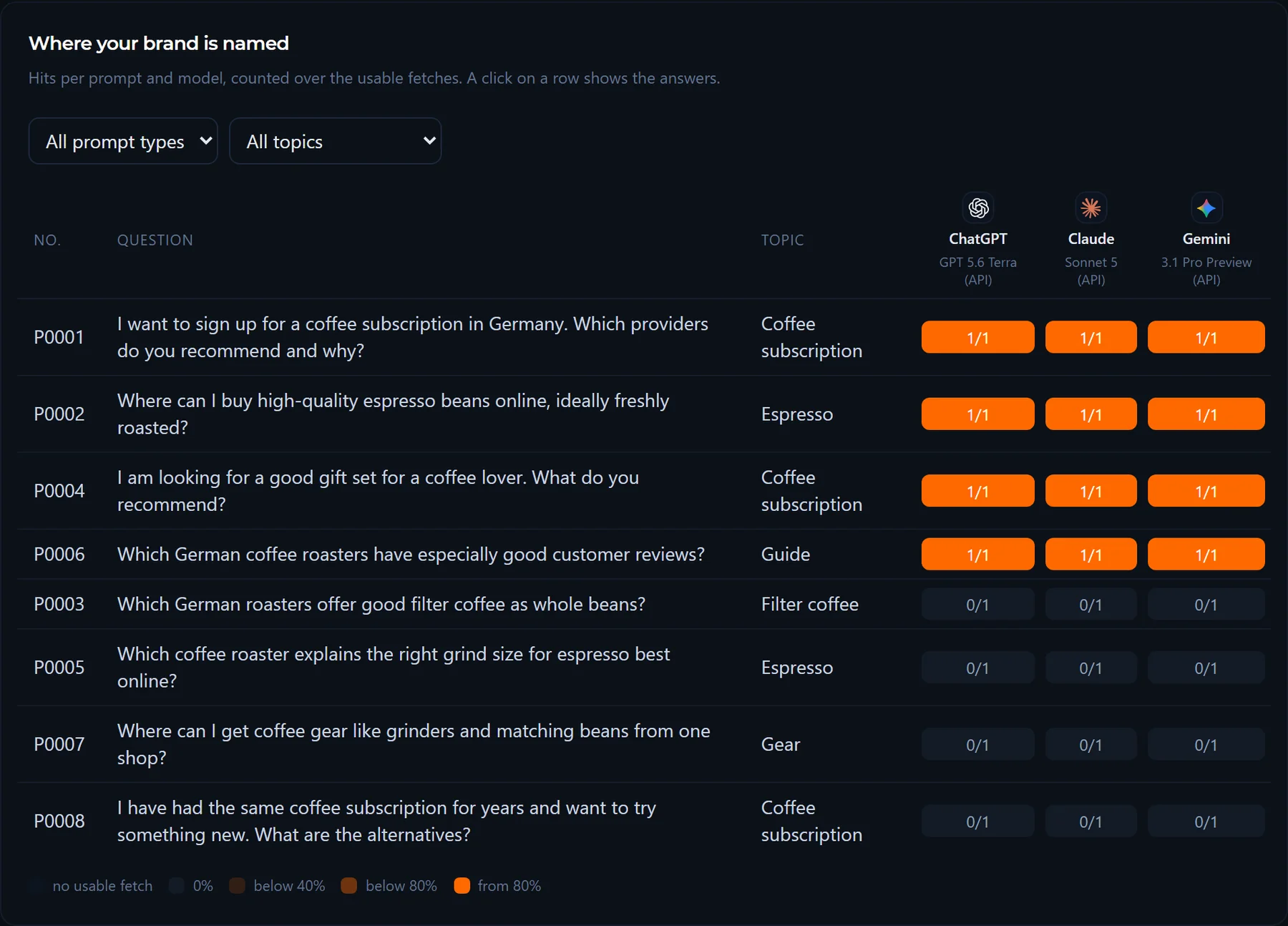
- Read the Deep Dive: The heatmap shows for every prompt and model whether your brand is named. One click opens the answer with all brands and sources.
- Save a schedule: The tracking runs every week. Only the trend over several runs shows whether your work pays off.
For a quick first look there is the free AI visibility check. It tests your brand in ChatGPT right away. You measure Gemini and Claude after a free sign-up.
Best visibility tools for AI search in 2026: three types of platform
When marketing teams compare AI visibility tools, they usually end up with one of three types of platform. Each one fits a different kind of team, so the best tool depends on how you work today.
| Type of platform | Examples | Best for | Check before you buy |
|---|---|---|---|
| SEO suite with an AI visibility module | Semrush, Ahrefs (Brand Radar) | SEO teams that already work in one suite | Which models are tracked, how many prompts, how often |
| Dedicated AI visibility tracker | Peec AI, Otterly.AI, Surfer AI Tracker | Content marketing teams focused on prompt tracking across models | Whether it connects to Search Console, analytics and revenue data |
| AI visibility plus SEO and content workflow | Visibly AI® | Agencies, consultants and in-house teams that want to track, plan content and publish in one place | A younger platform: check the models and the pricing for your prompt volume |
Classic SEO tools like Semrush and Ahrefs are strong on rankings, backlinks and keyword data. AI visibility tools add the layer that SEO tools were not built for: what the models actually say about your brand. Many SEO teams will use both.
What drives the pricing of an AI visibility tool?
The pricing model for AI visibility tracking is driven by four numbers: prompts, models, repetitions and frequency. Fifty prompts across four models with three repetitions every week is a very different volume from twenty prompts across two models once a month. In Visibly you see the estimated cost per call before every run, and you are billed for the actual cost. Plans are listed on the pricing page.
Free alternatives exist, but they have limits. The free AI visibility check gives you a first snapshot in ChatGPT, and manual prompts in each chat show a trend. Neither gives you history, competitor share of voice or stored answers.
Enterprise teams vs. small businesses
Enterprise SEO and marketing teams track several brands, markets and models, often daily, with role-based access for many people. Stored answers also help with compliance, because you keep a record of what an AI said about your brand on a given day. Small businesses need much less: one project, a small prompt set and a monthly run cover the essentials.
Which is the best tool for your team?
- Marketing agencies managing multiple clients: a marketing agency needs one project per client, team access and clean reporting. In Visibly you can also hand a finished project over to the client by link.
- E-commerce brands: track category and gift questions, map prompts to the buyer journey and weight visibility by the revenue of your keywords. AI Overviews matter a lot for product research.
- B2B SaaS companies: make AI visibility part of your go-to-market plan and track the questions behind AI-generated buying guides, such as "best software for X" or "alternatives to Y", and watch which comparison pages the models cite.
- Solo consultants on a limited budget: start with the free check and one small prompt set, and only add models and frequency once a client pays for it.
How to choose the best AI visibility tool
Social listening tools such as Brandwatch show where people talk about your brand on the web. They do not look inside AI answers. For that you need a dedicated AI visibility tool that sends prompts to the models and evaluates the answers. When you compare vendors and LLM SEO tools, check four points:
- Several models and repetitions instead of a single prompt
- Separate counts for mentions and links
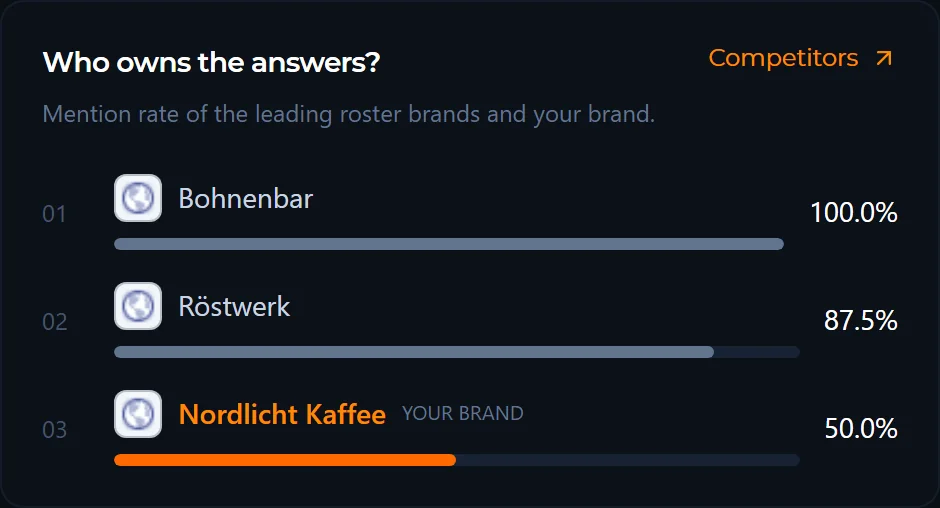
- Competitor analysis with share of voice
- Stored answers, so you can verify every number
Visibly also connects AI brand monitoring with your Search Console and Analytics data. Weighted by the revenue of your keywords, you see where being invisible costs the most. All tools are listed under Features.
How to improve your visibility in AI answers
The tracking shows which questions you are missing. Then you close the gaps one by one:
- Answer the questions you ignore today: In one project the prompt set contained many questions the website had no content for. Without a matching page, no AI can cite you.
- Give concrete facts: numbers, prices, specs, locations. A study on Generative Engine Optimization (GEO) found that citations, quotations and statistics can raise visibility in generative answers by up to 40 percent (Aggarwal et al., GEO: Generative Engine Optimization, arXiv 2023).
- Fix load time and readability first: For one shop we improved load time and readability before adding any new content. Hard-to-read pages work neither for people nor for machines.
- Raise your content quality: content that answers the question in the first sentences, uses tables and clear headings and names its sources is easier for the models to quote. Thin content rarely gets cited.
- Get mentioned beyond your own site: AI systems name brands that others write about. The list of cited sources shows where a guest article or a listing is worth it.
If you want to know how to rank in ChatGPT, this is the honest answer: there is no ranking switch. You earn mentions with pages that answer the real questions and with sources that already talk about you. Google says in its guidance on AI features in Search that the same principles apply to AI Overviews as to regular search.
AI visibility as a KPI: how to justify the ROI to your CMO
Executives do not want prompt lists. What works for me is three numbers side by side: the mention rate for questions with the brand, the mention rate for generic questions and the share of voice of the two strongest competitors. The gap between the first two shows right away how many potential customers never meet the brand in the chat.
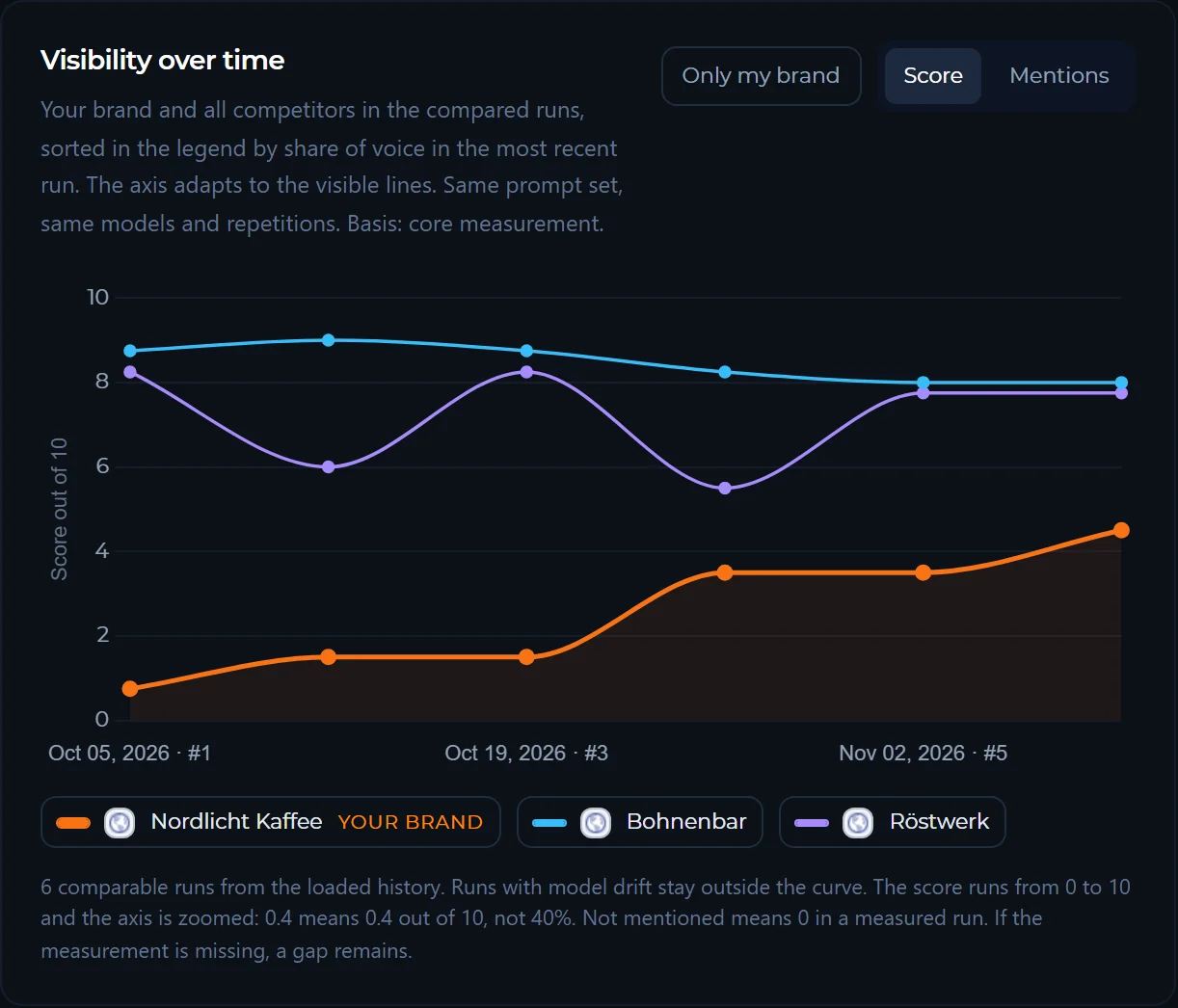
For the ROI case, connect visibility to money. Visibly weights AI visibility by the revenue of the keywords behind each question, so you can show where being invisible costs the most. Be honest about the limits: AI referrals in analytics capture only part of the traffic, and no tool can prove that a single mention caused a purchase.
With a small budget, start with the free check, then set up a small prompt set and track it once a month. That is enough to find the biggest gaps.
FAQ
What does an AI visibility tool do?
It sends fixed prompts to several AI models, stores the answers and counts how often your brand is named, linked and recommended, compared with your competitors.
How fast does AI visibility change?
For models with web search you often see the effect of new content within a few weeks. Answers from training data only change with new model versions.
Do I need visibility tracking for AI search if I already do SEO?
Yes, if buyers in your market ask AI assistants before they buy. SEO tools show rankings and clicks; they do not show what ChatGPT or Gemini say about your brand. Most teams run both side by side.
Can I track AI visibility without a tool?
Ask ten fixed questions in ChatGPT, Gemini and Perplexity, three times each, and note who gets named. That shows a trend. For history and competitor comparisons you need a tool.
Methodology: search volumes from our own research with Visibly AI® on 9 November 2026 (United States). The practical examples come from our own tracking runs in client projects with LLM Visibility (fixed prompt sets, several models, repetitions) and from conversations with clients and prospects, September to November 2026, transcripts stored locally and anonymized.
How visible is your website on Google and in AI answers? Run the free visibility check.
Check for free