Claude SEO: audits, skills and live data with MCP

AI summary
- Claude SEO means using Claude for audits, keyword research, content and reporting, with three ingredients: a CLAUDE.md file, skills and live data through MCP.
- A skill makes an audit repeatable; without data it produces a checklist, with data from Search Console and a crawler it produces an audit.
- The Visibly AI MCP server provides 91 tools (as of November 12, 2026); with Search Console connected, click data comes straight from Google.
- Claude does not replace an SEO team: machine-checkable work such as schema markup can be automated, strategy and approval stay with a person.
- Own measurement on this blog: no first draft scored above an NSS of 80, two to four revision rounds added 8 to 24 points.
Created with AI, the details are in the article.
Table of contents
- What is Claude SEO and how does it work?
- What is a CLAUDE.md file and how is it used for SEO analysis?
- What are Claude SEO skills for AI-powered search optimization?
- Connecting Claude to live SEO data with MCP
- How do Claude Code SEO automations work in practice?
- Original research: how this blog is written with Claude
- What is GEO and AEO in the context of Claude SEO skills?
- Claude vs ChatGPT for SEO audits: which is better?
- Can Claude AI replace a full SEO team for a website?
- How to build an SEO strategy using Claude Code?
On 30 September 2026 I sat in a biweekly call with an industrial client. The list: schema markup, meta tags and internal links for several hundred pages, one page at a time. The usual route in that company is a ticket to IT and a wait of several weeks. For my own website I had handed the same job to Claude in about five minutes, and the schema has been generated automatically ever since.
The difference was the interface, and that is what Claude SEO comes down to. The model can only do as much SEO as the data and systems it is connected to. In this article I explain what Claude SEO is, how CLAUDE.md, skills and MCP fit together, what an AI SEO audit looks like in practice and where it fails. I also show how to connect it to live Search Console data with Visibly AI®.
What is Claude SEO and how does it work?
Claude SEO means using Claude, the AI model built by Anthropic, for search engine optimization work: audits, keyword research, content and reporting. It is a language model, a product of artificial intelligence research: machine learning trained it, and natural language processing lets it read your instructions in plain English. On its own it knows nothing about your website today. It becomes an SEO tool when you give it three things:
- Instructions: a CLAUDE.md file with your rules, your clients and your way of working.
- Skills: packaged procedures, for example "run a technical SEO audit for this URL".
- Tools: live data from Search Console, a crawler, a SERP check and your CMS, usually connected through MCP.
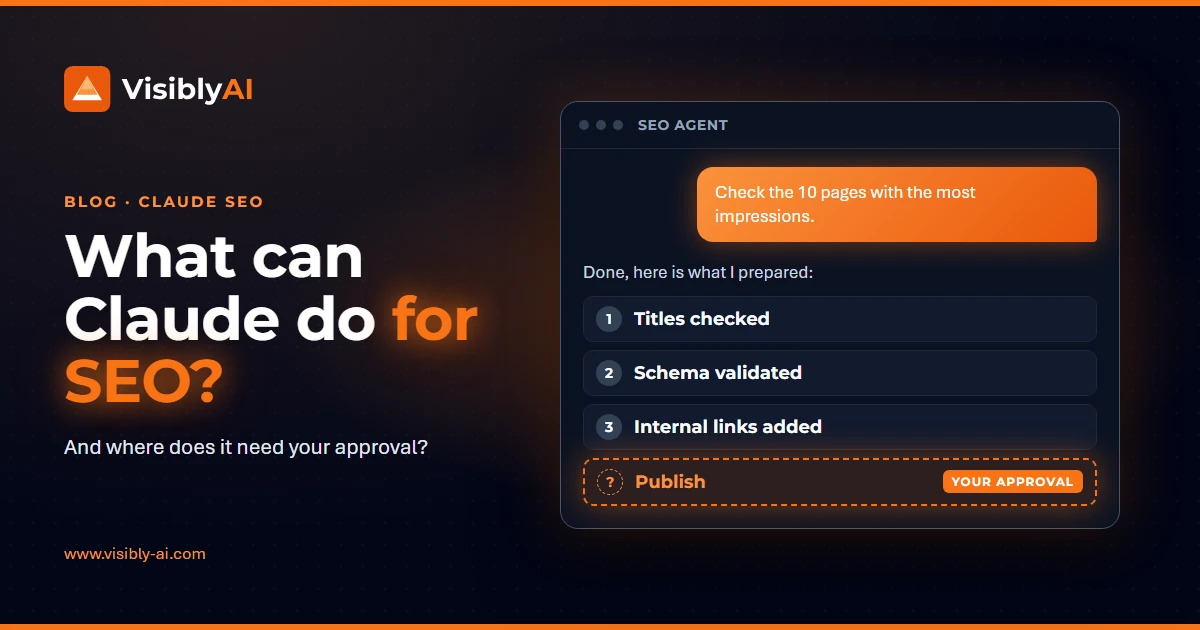
With those three in place, the model works like an agent. It plans the steps, calls a tool, reads the result and decides what comes next. A chatbot answers one question. An agent finishes a task such as "check the ten pages with the most impressions and suggest a better title for each URL".
How to use Claude AI for SEO audits and optimization?
You provide a URL, a goal and access to data. For a single page, an on-page audit checks title, meta description, headings, canonical, robots directives and schema. For a whole site, a crawl collects the same signals for every URL, and the findings are sorted by impact. The optimization step follows from the audit: the assistant drafts the new title, the missing section or the schema markup for that URL, and you approve it.
What SEO metrics can Claude analyze automatically?
Every metric a connected tool returns. In my setup that covers clicks, impressions, click-through rate and position per query and page from Search Console, Core Web Vitals such as LCP and CLS, broken links, hreflang, structured data, and backlink figures like referring domains. The assistant compares months, finds the pages that lost search rankings and lists a likely cause for each one. Judging whether the cause is right stays with you.
What is a CLAUDE.md file and how is it used for SEO analysis?
CLAUDE.md is a plain text file that Claude Code loads at the start of every session. It holds the context you would otherwise repeat in every prompt. For SEO analysis mine contains the CTR model I use for traffic estimates, the naming rules for client folders, the preferred tools and the rule that every number needs a source and a date.
How to set up Claude as an SEO tool using CLAUDE.md?
- Install Claude Code and open a folder for your SEO work. The basics are in my Claude Code guide.
- Write CLAUDE.md: who you work for, which data sources exist, how results should be formatted. Start with twenty lines and extend it whenever the same mistake happens twice.
- Add skills for recurring jobs such as an audit or a monthly report.
- Connect data through an MCP server, so the model reads real numbers for each URL and query.
- Run one task and check the result on the live page before you trust the next one.
What are Claude SEO skills for AI-powered search optimization?
A skill is a folder with a SKILL.md file that describes one procedure step by step. It is loaded when the task matches. Natural language processing is the reason a skill can be plain text: the procedure is written the way you would brief a colleague. Skills turn a good prompt into a repeatable process: the same audit, in the same order, with the same output format, for every client. For AI-powered search optimization that matters because an audit you cannot repeat cannot be compared month over month.
What is the Claude SEO skill open-source framework?
The best-known open source example is claude-seo by Agrici Daniel, published on GitHub under the MIT license. According to its README it bundles 26 sub-skills and 19 sub-agents for Claude Code, covering technical SEO, schema, E-E-A-T, local SEO and GEO, with commands such as /seo audit and /seo technical followed by a URL (as of 12 November 2026). I have read the repository and have not used claude-seo in client work, so treat this as a description. The claude-seo repository on GitHub also contains its own CLAUDE.md and SKILL.md files, which makes it a good place to study how a large skill is structured, even if you never install it.
My own open source contribution is smaller: the SEO Starter plugin for Claude Code with skills for a status quo analysis, a potential analysis and a proposal, also public on GitHub. Whichever framework you pick, a skill without data produces a checklist. A skill with data produces an audit.
Connecting Claude to live SEO data with MCP
Anthropic published the Model Context Protocol in November 2024 as an open standard for connecting AI assistants to the systems where data lives (Anthropic, Introducing the Model Context Protocol). I explain it to clients like this: MCP is a collection of APIs behind one interface. The model sees a list of tools with descriptions and calls them itself.
The Visibly MCP server provides 91 tools, eight of which work without an API key. Setup takes five steps:
- Create an API key in Visibly under Settings, "API key & MCP". It is shown in full only once.
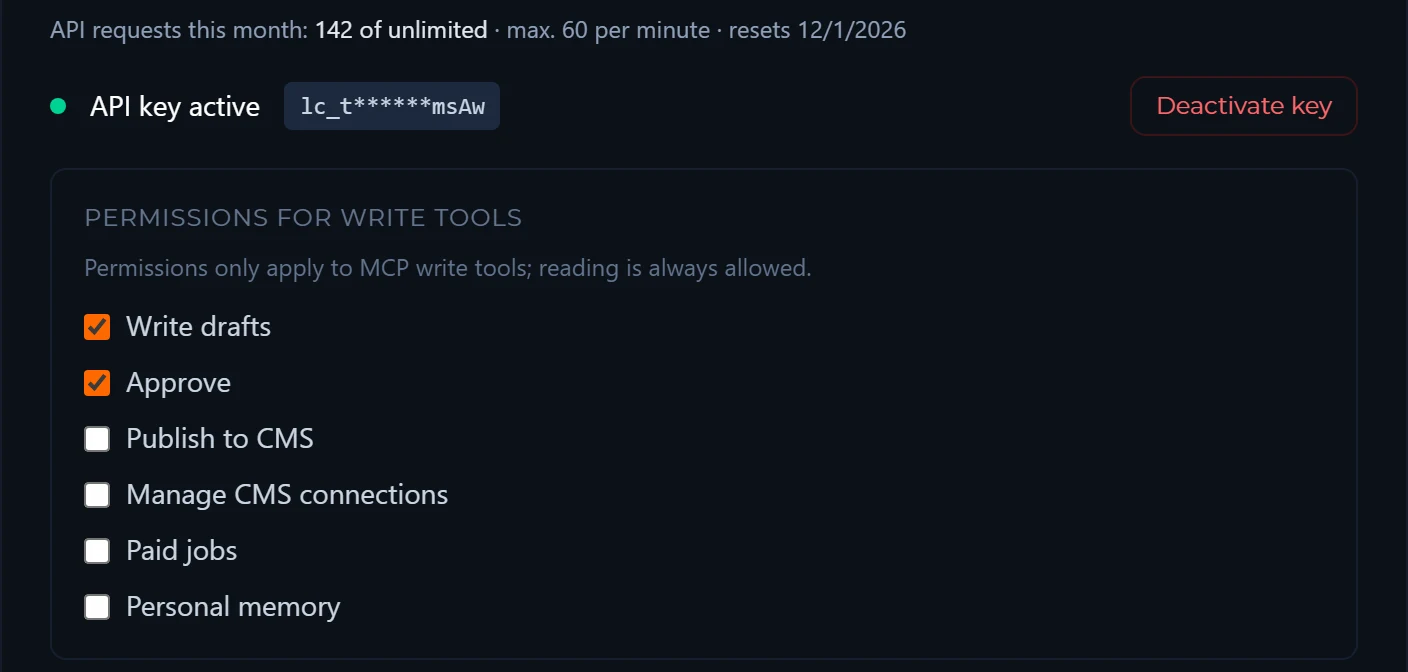
- Set permissions. Reading is always allowed. Drafts, approvals, publishing to the CMS and paid jobs each have their own switch. I start with reading and drafts only.
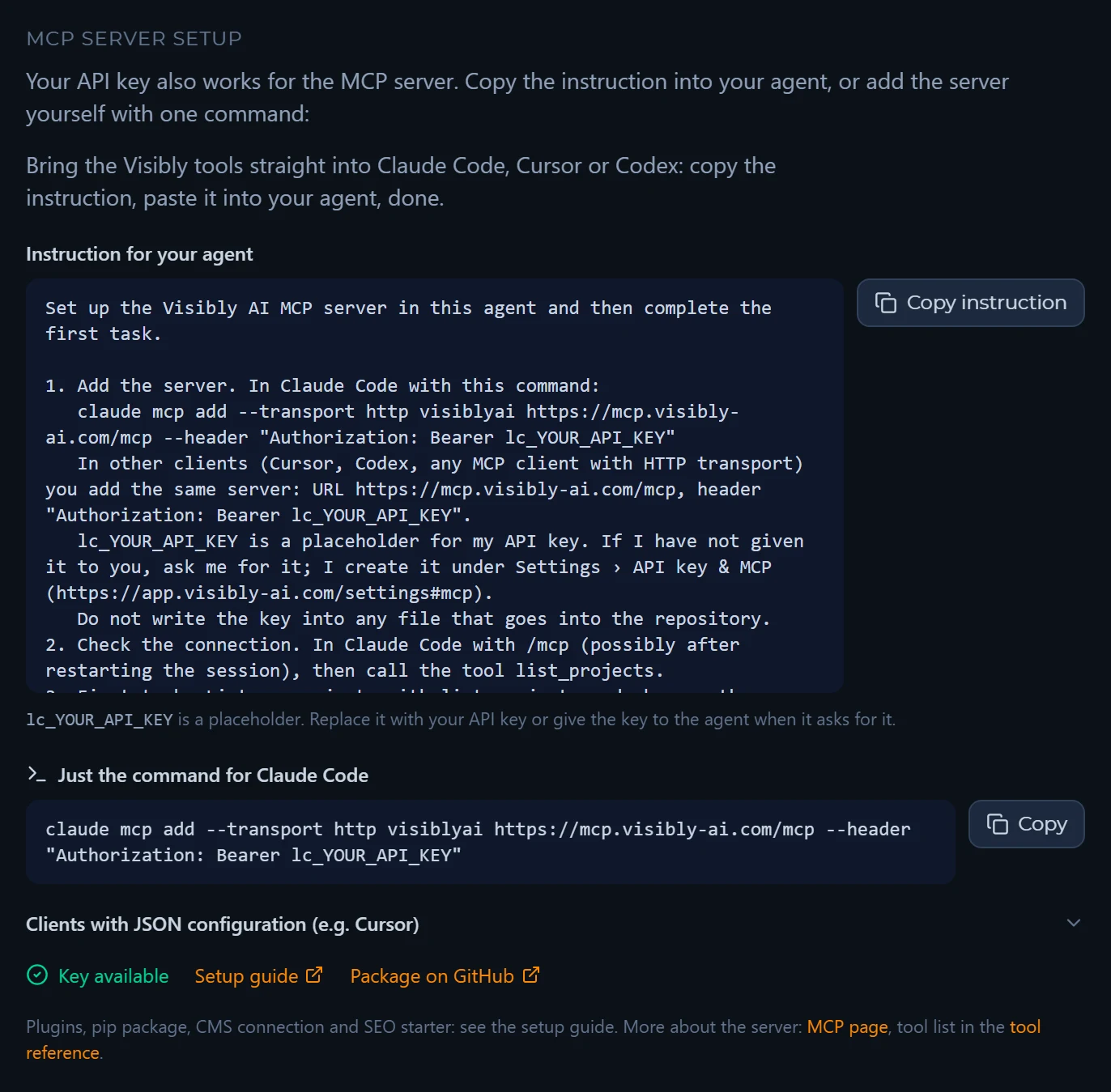
- Connect. In the Claude app, add a custom connector as described in the Claude connector guide. In Claude Code, one command from the quick install guide is enough.
- Ask for something real: "Show me my projects and the biggest quick wins from Search Console." With Search Console connected, the numbers are real click data from Google and cost no credits.
- Verify. Read every recommendation against the live page before it goes into a task list.
API and MCP access are part of the Standard plan and above, see pricing.
How do Claude Code SEO automations work in practice?
They work as a loop: generate, validate, correct. Whether the loop ever reaches your website depends on the interface.
Case study: schema markup for an industrial client
This case study shows the limit first. At the industrial client from the introduction, the page builder had no interface for AI agents, while the CMS vendor did. Then came IT security: Claude Code was not approved for the team, and approval runs as a business request through a committee that meets every two weeks. So the schema audit ran on my side and the result went back as an Excel file. Clarify the way back onto the website before you choose any tool.
Where the interface exists, the automation is a loop with a guardrail. Claude Code generates the schema markup for a URL, a script runs the Schema Markup Validator, and any error goes back to the model until the schema for that URL is valid. No language model is error-free, so the validator decides and the model only proposes. Code execution makes this possible: the model writes the script, runs it and reads the result.
As an SEO professional, how can I use Claude to automate my workflow?
Automate what you can check in five minutes: the monthly report from Search Console and Analytics, the on-page audit of new pages, keyword analysis for a briefing and the first draft of a rewrite. Decisions about budget, priorities and tone stay with you. From the third repetition of a task on, I write the steps down as a skill.
As a developer, how do I build a custom SEO audit tool using Claude Code?
Combine three parts: a crawl that returns one record per URL, a set of checks with a clear pass or fail, and a report template. Through MCP, Claude Code can call a 24-point on-page audit for a URL, validate structured data and check links, then write the findings to a file. Add a validator for anything machine-checkable. Keep the checks in a skill so the tool behaves the same next month.
Original research: how this blog is written with Claude
This blog is produced with the workflow described here. I create an analysis for the keyword in Visibly, which costs 38 credits. The model reads the briefing with terms, entities and fan-out questions through MCP. I add my notes from client conversations, and the draft is scored against the NSS at no credit cost. For this original research I evaluated our own data, the scores of the first three articles:
| Article | NSS per round | Rounds |
|---|---|---|
| AI visibility (German version) | 61 → 85 | 4 |
| Query fan-out (German version) | 65 → 74 → 79 → 80 | 4 |
| Query fan-out (English version) | 79 → 87 | 2 |
No first draft scored above 80. Revision rounds added 8 to 24 points, mostly through missing fan-out questions and entities. The draft lands in the editor, and nothing is published before I approve it.
One finding from this very article: the briefing listed several Dutch words as required terms, because the analysis had read a bot-check page from the search results. A model optimizing blindly for the score would have written them into an English text. I left them out.
What results have people achieved using Claude for SEO campaigns?
I can only vouch for my own results. On my own website, the schema markup for every URL has been generated automatically since I handed the job over. On this blog, revision rounds lifted the scores shown above. What I cannot show yet is an effect on search rankings: these articles are a few days old. Three months of Search Console data are the minimum before I would call anything a result, and I would distrust any case study that reports one sooner.
What is GEO and AEO in the context of Claude SEO skills?
GEO stands for generative engine optimization, AEO for answer engine optimization. Both describe the work of getting your content cited in AI answers from ChatGPT, Gemini, Perplexity and Google's AI Overviews. Answer engine optimization rewards passages that answer one question directly. In SEO GEO skills, this usually means two checks. The first is a query fan-out check: which sub-questions does an AI derive from a keyword, and does your page answer them? The second is measuring how often the models mention your brand, which I cover in the article on AI visibility tools.
GEO in this sense has nothing to do with geo-targeting. For local SEO and geo-targeting you need keyword and ranking data per country or region, which is a data question again.
Claude vs ChatGPT for SEO audits: which is better?
For an SEO audit the model matters less than the tooling around it. I use Claude for agent work because Claude Code, skills and MCP fit together well, and I use Codex from OpenAI with the same MCP server for a second opinion. Both find the missing H1. The audit gets better when the data is real and the procedure is fixed, whichever model runs it.
Is Claude better than Gemini for search intent analysis and content gap research?
I have not seen a reliable public benchmark for this, so I will not claim one. For search intent, the source decides: a model that reads the actual top results for a query classifies user intent better than one that guesses from the keyword. For content gap analysis the same holds. Give Claude or Gemini the SERP and your page, and both will find content gaps. Give them nothing, and both will invent some.
How does Claude compare to traditional SEO tools like Ahrefs or Semrush?
They do different jobs. Ahrefs and Semrush own data: a backlink index, a keyword database, rank tracking. A language model owns no index. It reasons over data and does the steps in between. A guest on my podcast told me that an SEO interface connected through MCP returned a search volume of 20,000 and then 200 for the same keyword in one chat. Since then I have every number printed with its source and date.
Claude SEO skills vs paid SEO tools like Semrush or Surfer SEO?
Skills replace clicks, and they do not replace data. A content tool like Surfer SEO gives you term recommendations from the SERP. A skill can use such recommendations, write the text and measure it again. I would keep one paid data source and let skills do the repetitive work on top of it.
Claude Code SEO vs using dedicated SEO software for content strategy?
Dedicated software shows you the market: demand, competitors, gaps. Claude Code turns that into a plan and into drafts. For content strategy I let it cluster Search Console queries by search intent and map them to existing pages. Which cluster earns money is a business decision, and no software knows your margins.
Claude SEO audit vs manual SEO audit: pros and cons?
| Audit with Claude | Manual audit | |
|---|---|---|
| Speed | Minutes for hundreds of URLs | Days |
| Consistency | Same checks every time, if they live in a skill | Depends on the person |
| Judgment | Weak on business context | Strong |
| Errors | Wrong matches that look plausible | Missed pages |
In our fan-out check, one sub-question counted as covered although the matched section said the opposite. I read every finding near a threshold myself.
Free Claude SEO tools vs premium AI SEO platforms?
Free and open source skills such as claude-seo cost nothing to install, and you bring your own Claude subscription and data. A platform adds the data, projects per client, permissions and a place where drafts and scores are stored. If you already pay for Claude, writing and revising with your own model and paying a platform only for analysis is the cheaper split.
Can Claude AI replace a full SEO team for a website?
No. It replaces routine and speeds up analysis. It does not own results. Google Search Central states the risk of scale without value plainly:
"Using generative AI tools or other similar tools to generate many pages without adding value for users may violate Google's spam policy on scaled content abuse."
Google Search Central, guidance on using generative AI content, last updated 1 October 2026
Artificial intelligence makes it easy to produce exactly that. Someone has to decide what gets published, and that person needs SEO experience.
As a small business owner, can I use Claude to handle my entire SEO strategy without an agency?
You can handle the routine: reports, on-page fixes, first drafts. For the strategy you need someone who can check the output, which can be you if you invest the time. Start with one task, the monthly Search Console report. When that is right, add the next one.
As a startup founder, how can Claude help me get more organic impressions quickly?
Quickly is relative in SEO. The fastest lever I know is striking distance: queries where a page already ranks on position 4 to 20. The assistant finds them in Search Console in seconds, compares each query with the title and headings of the page and drafts the missing section. Search rankings move after the change is live and Google has re-evaluated the page.
As a content marketer, how do I use Claude to find content gaps and search intent?
Ask for the fan-out questions behind your keyword, then have them matched against your page. Unanswered questions are your content gaps. For search intent, have the model read the top results and label each one as informational, commercial or transactional. In a conversation with a content partner in October 2026, this was the point: a blog article in WordPress used to take half a day and now stands in minutes, and the saved time goes into her own examples.
As a freelancer, how can I offer AI SEO audits to clients using Claude skills?
Package the audit as a skill, run it per client project and deliver a report with sources. As a freelancer with several clients, separation matters most to me: every client is one project with its own brand rules, connected Search Console and memory. Team members read through MCP on the project owner's data and keep their roles. Tell the client what was checked by a machine and what you verified yourself. That sentence is what they pay for.
How to build an SEO strategy using Claude Code?
- Status quo: pull twelve months of Search Console data per query and page.
- Keyword research: cluster the queries by topic and intent, validate search volume for the gaps.
- Technical SEO: run the audit and fix what blocks crawling and indexing first.
- Content plan: one page per cluster, with the fan-out questions as outline.
- Measurement: the same report every month, produced by the same skill.
I am preparing a three-day Claude SEO seminar for a German training provider, first run in December 2026, and this sequence is its backbone. All tools of the server are listed in the MCP documentation, all platform functions under features. For a first look at your brand in ChatGPT there is the free visibility check.
Methodology: figures on the MCP server (91 tools, eight without an API key) and plans from www.visibly-ai.com, as of 12 November 2026. Search volume "claude seo": 590 per month in the United States, Visibly AI, 12 November 2026. Figures on claude-seo from the project's README on GitHub, 12 November 2026. NSS history from my own work on this blog, 9 and 10 November 2026. Experience from my own conversations with clients and prospects and from my own podcast, September to November 2026, transcripts stored locally, anonymized.
How visible is your website on Google and in AI answers? Run the free visibility check.
Check for free