E-E-A-T SEO: how to measure experience and trust

AI summary
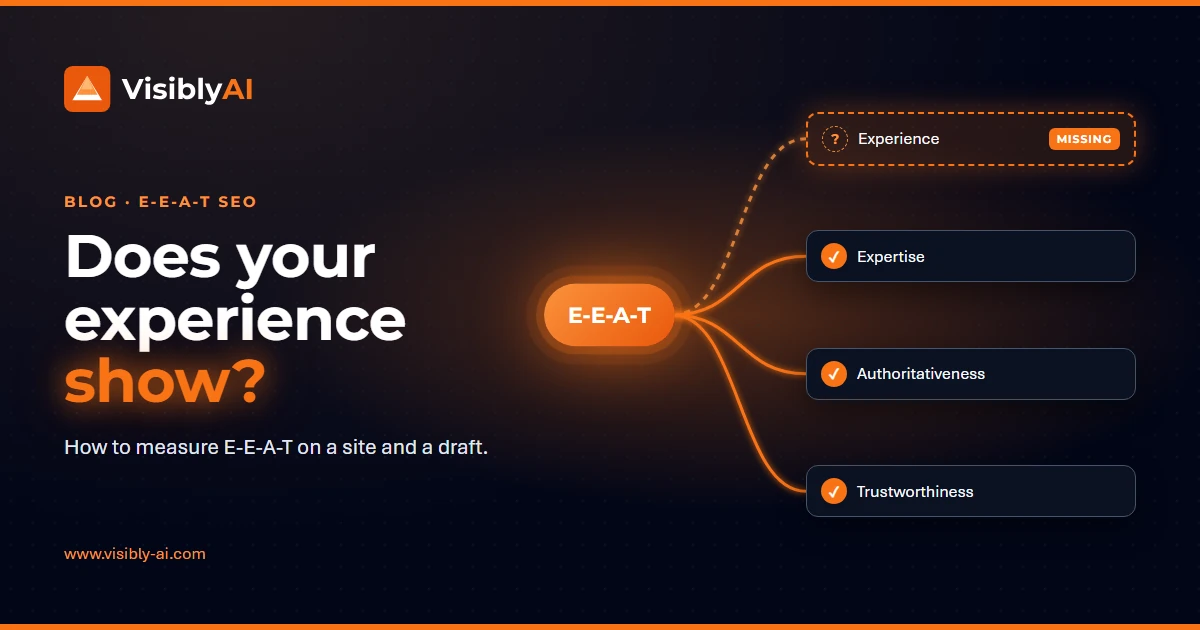
- E-E-A-T stands for Experience, Expertise, Authoritativeness and Trustworthiness.
- According to Google Search Central, trust is the most important of the four; E-E-A-T itself is not a specific ranking factor (as of October 5, 2026).
- The extra E for first-hand experience has been part of the Search Quality Rater Guidelines since December 15, 2022.
- The standard is strictest for YMYL topics such as health, finance, legal and safety.
- Own measurement on an article draft: experience first scored 0 because case studies sat unlabeled in the copy; after the revision the overall value rose from 48 to 58.
Created with AI, the details are in the article.
Table of contents
- E-E-A-T SEO: what does E-E-A-T stand for in SEO?
- E-E-A-T ranking: does E-E-A-T directly affect Google's ranking algorithm?
- From E-A-T to E-E-A-T: how does the extra E for Experience change SEO strategies?
- What types of content are most affected by E-E-A-T requirements?
- How does Google measure trustworthiness of a website?
- What is the difference between E-E-A-T and traditional SEO ranking factors?
- Original research: measuring E-E-A-T on a draft
- How do I improve my website's E-E-A-T score for better Google rankings?
- How does E-E-A-T apply differently to AI-generated content versus human-written content?
In October 2026 I had a first call with the team of a health platform. Their advice articles were written with generative AI, well structured and free of errors. They did not rank. Almost every click came from searches for the brand name. The content lacked what Google wants to see on health topics in particular: a visible author, sources and first-hand experience.
That gap has a name: E-E-A-T. In this article I explain what it means in SEO and what the Search Quality Rater Guidelines say. I answer whether it is a ranking factor. And I show how to measure the signals on a whole site and on a single piece of content, and what such a measurement cannot tell you.
E-E-A-T SEO: what does E-E-A-T stand for in SEO?
E-E-A-T stands for Experience, Expertise, Authoritativeness and Trustworthiness. Google uses the concept to check whether its search systems surface helpful and reliable information. For search engine optimization this means your content should show who wrote it, where the knowledge comes from and why a reader can trust the site. Good SEO makes this information visible. Search engine optimization cannot replace it.
What is the meaning of Experience, Expertise, Authoritativeness, and Trustworthiness in SEO?
| Pillar | Question behind it | What it looks like on a page |
|---|---|---|
| Experience | Has the author used, visited or lived through the topic? | Case studies, own data, own photos, concrete steps |
| Expertise | Does the author have the necessary knowledge? | Author bio, qualifications, methodology, correct terminology |
| Authoritativeness | Is the source recognized in its field? | Mentions, backlinks, citations by others |
| Trustworthiness | Is the page honest, safe and verifiable? | Legal notice, contact details, sources, current data, clear prices |
The four pillars do not carry equal weight. Google Search Central puts it in one sentence:
"Of these aspects, trust is most important."
Google Search Central, Creating helpful, reliable, people-first content, last updated 5 October 2026
Trust sits in the middle, and experience, expertise and authority feed into it. A page with a lot of expertise that readers cannot trust is weak by this logic.
What are Google's E-E-A-T guidelines and why do they matter?
There is no separate rulebook. The concept is described in the Search Quality Rater Guidelines, a handbook for the external reviewers who assess search results. The guidelines matter because they are the most precise public description of what Google considers quality content. Before you trust a summary in a marketing blog, read the passage in the original. A lot of SEO and content marketing advice on the topic is found in no guideline.
E-E-A-T ranking: does E-E-A-T directly affect Google's ranking algorithm?
It is not a single ranking factor. Google says so in its own words: "While E-E-A-T itself isn't a specific ranking factor, using a mix of factors that can identify content with good E-E-A-T is useful." (Google Search Central). No score is stored per page. The systems use many ranking signals that together are meant to identify credible content. Site owners can work on those signals with SEO and content work.
What are Google's Search Quality Rater Guidelines and how do they relate to E-E-A-T?
Search quality raters are people who assess search results on behalf of Google according to the guidelines. Their ratings do not change any individual ranking. They are used to evaluate and train the systems. The guidelines are the specification: this is what good results should look like. The concept is the part of that specification that deals with credibility.
How does E-E-A-T influence Google's search quality evaluation?
A quality rater looks at the main content of a page, at who is responsible for it and at the reputation of the site and the author. A weak result on these points is a reason to rate a page low, however well it matches the keyword. That is how the concept shapes the evaluation. The evaluation in turn shapes how the algorithm is developed.
How does Google's E-E-A-T framework affect website rankings?
Indirectly. Pages that show clear authorship, sources and real experience send more of the signals the systems look for. At the health platform, the articles were relevant and still lost. Nobody stood behind the content. Rankings moved for brand searches only, where trust in the name already existed.
From E-A-T to E-E-A-T: how does the extra E for Experience change SEO strategies?
Until December 2022 the concept was called E-A-T. On 15 December 2022 Google updated the guidelines and added Experience (Google Search Central Blog, December 2022). For SEO the change rewards first-hand knowledge: actual use of a product, an actual visit, something a person lived through. For your SEO strategy this means two things. A field report can be valuable even if the author holds no formal title. And a polished summary of other people's content has become weaker.
What types of content are most affected by E-E-A-T requirements?
Content where wrong information can cause harm. The guidelines call it YMYL, short for "Your Money or Your Life": health, finance, legal and safety topics. News and online shops come next, because money and decisions are involved.
Are YMYL websites held to a higher E-E-A-T standard than other sites?
Yes. For YMYL topics the guidelines set the bar higher. Everyday experience is enough for a recipe. For a medication dose, raters expect formal expertise and a trustworthy source. The health platform from the introduction sat exactly in this area.
As a healthcare or legal website owner, what extra E-E-A-T requirements should I be aware of?
- Every expert article names an author with qualifications and a profile page of their own.
- Medical and legal statements link to primary sources: guidelines, laws, studies.
- A visible date shows when an expert last reviewed the content.
- Legal notice, professional registration and contact details are complete and easy to find.
- Drafts produced with generative AI are always reviewed by a qualified person before they go live.
How does Google measure trustworthiness of a website?
Google does not publish a trust metric. From the guidelines you can derive what raters check: who is responsible for the site, whether contact and customer service information exists, whether claims are sourced, whether the page is safe to use and what others say about the site. On the page itself, trust is mostly a matter of being verifiable. A number with a source and a date can be checked. A claim without them cannot.
How do author credentials and bios impact E-E-A-T signals?
An author bio answers the first question a rater asks: who wrote this? A useful bio names the person, their role, their experience with the topic and links to profiles elsewhere. Structured data for author and organization helps search systems connect the name with other mentions. A bio does not create expertise. It makes existing expertise visible.
What is the difference between E-E-A-T and traditional SEO ranking factors?
Keywords and backlinks are measurable signals. E-E-A-T is a quality standard that describes what those signals should add up to. A backlink from a specialist site signals authority. A keyword in the title only says what the page is about. Traditional SEO factors answer the question of relevance. The quality concept answers the question of reliability.
How does E-E-A-T compare to domain authority as a ranking signal?
Domain authority is a metric from SEO tools that estimates the strength of a link profile. Google does not use it. It can hint at authoritativeness, one of the four pillars, and says nothing about experience or trust. A site with a strong link profile and anonymous, unsourced content still has a credibility problem.
Which matters more for E-E-A-T: on-page content signals or off-page authority signals?
You control on-page signals today: authorship, sources, own data, case studies. Off-page authority takes time and depends on others. I start on the page, because content credibility is the precondition for anyone wanting to cite or link to you. Digital marketing and PR can amplify expertise that is visible. They cannot amplify expertise nobody can see.
Original research: measuring E-E-A-T on a draft
For this original research I evaluated our own data: the E-E-A-T signals Visibly AI® measured on the draft of our article on Claude SEO and its German counterpart on 12 November 2026. The editor checks eight text signals and assigns them to four dimensions.
| Dimension | Signals checked | First German draft |
|---|---|---|
| Trust | Named author, linked sources | 65 |
| Expertise | Methodology described, data table, expert quote | 75 |
| Experience | Original research, case study | 0 |
| Authority | Sources classified as primary or industry source | 30 |
The overall value was 48. The zero for experience stood out. The text contained several observations from client projects, but they were scattered through the copy without any label. After a revision with a dedicated case study section and a table of our own measurements, the value rose to 58. The English version went from 58 to 73.
Two lessons from this. First, experience has to be recognizable for readers and machines. Second, the measurement checks signals in the text. It did not recognize a quote from Google's documentation as an expert quote, and no tool can verify whether the experience is real. Visibly states this itself on the NSS page: the text signals do not verify actual experience, qualifications or factual accuracy.
How do I improve my website's E-E-A-T score for better Google rankings?
There is no official score, so improving means making existing experience and expertise visible. Neither can be invented. In Visibly the workflow for a whole site looks like this:
- Create a project. Visibly suggests the YMYL area from your website. You can change it in the project details. In such an area the analysis rates more strictly.
- Choose competitors. The analysis scores your domain compared with the competitors stored in the project.
- Read the analysis. You see a value per pillar and the findings behind it. I read the weakest pillar first.
- Work through the tasks. Findings turn into tasks, for example missing author information on advice pages.
- Watch the trend. The analysis runs regularly, a weekly report arrives by email, and the report is available as a PDF.
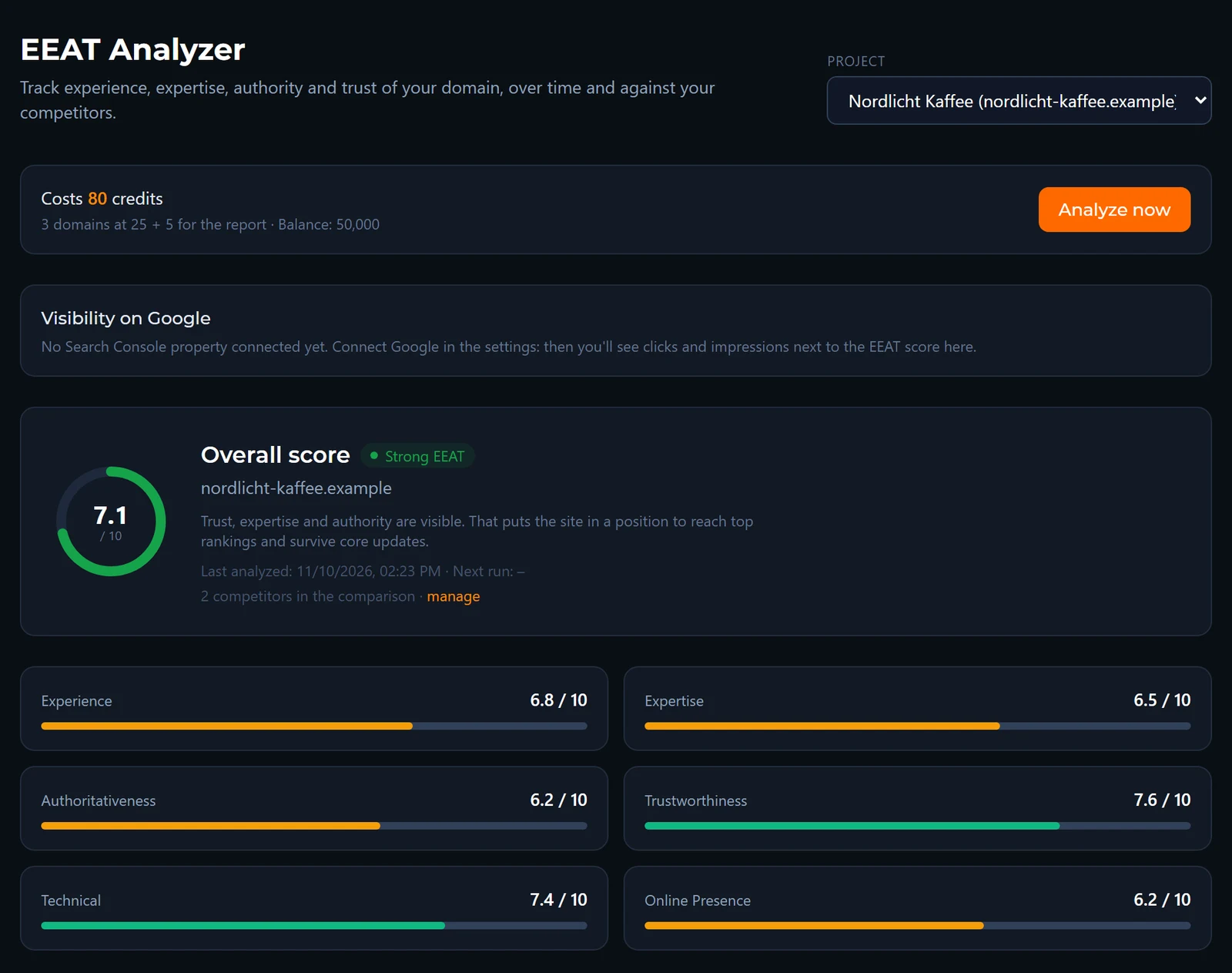
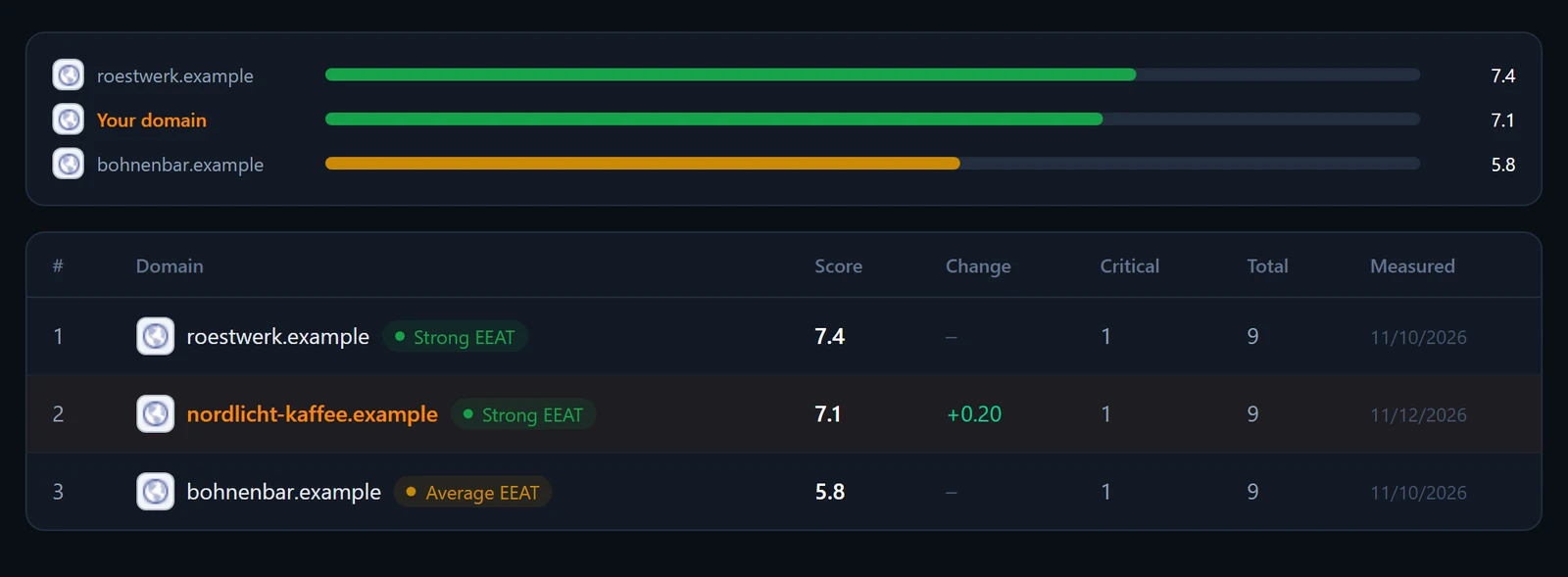
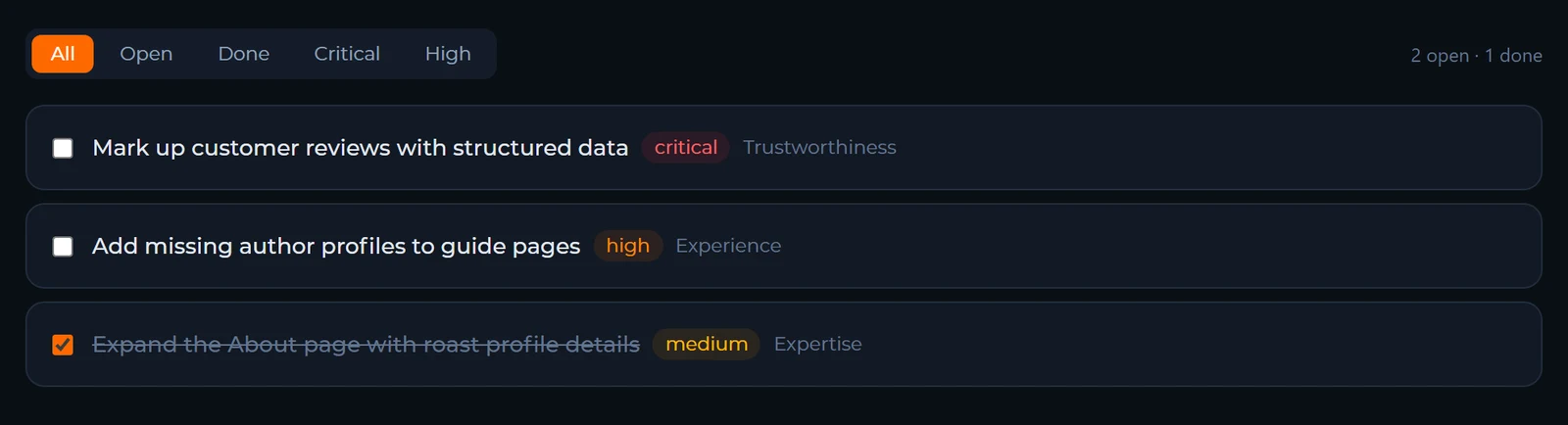
For a single article you measure in the editor, which shows the signals of the current draft. You can measure again after every change. All functions are listed under features.
As an SEO agency, how do I audit a client's website for E-E-A-T compliance?
Audit by page type. Take the twenty most important pages and check five things on each. Is there a named author with a bio? Does every figure have a source and a date? Is there at least one element of first-hand experience? Are contact and legal information complete? When was the content last updated? Record the findings per pillar. Clients understand "trust: no return policy on product pages" better than an abstract score.
As a content marketer, what specific steps should I take to demonstrate E-E-A-T on my blog?
- Open with an observation from your own work.
- Back every number with a source and a date.
- Add one case study or own data set per article and label it as such.
- State where your experience ends.
- List your sources and the period of your observations at the end.
My own process for SEO and content marketing: after every client conversation and workshop, the key statements go into an anonymized collection. When I write, I search there first and place the observations in the sections where they belong.
As a small business owner, how can I build E-E-A-T without a large team of experts?
Use what a small business has and a large brand often lacks: real, close experience with customers. You do not need a marketing team for that. Answer the questions your customers ask, show your own work in photos and name the person behind the business. For local SEO, complete and consistent business information is part of trust, and in local search a real address and real reviews show expertise on the ground better than any marketing claim.
Is E-E-A-T more important for small businesses than for large brands?
It is a different problem for each. Large brands bring authority and often publish content without a name, so experience is missing. Small businesses can show experience credibly and have to build authority first. For both, start with the weakest pillar.
As a freelance writer, how do I build personal author authority to improve E-E-A-T signals?
Publish under your name in one field, keep an author page with your focus and references, and link your profiles. Describe projects in anonymized form: starting point, approach, result, what did not work. Guest articles and interviews in your niche add authority over time.
As an e-commerce store owner, how does E-E-A-T affect my product pages and overall site trustworthiness?
In a shop, trust decides the purchase. Show complete contact details, clear shipping and return terms, real reviews and secure payment methods. Product copy gains from experience: own photos, measurements from your own test, answers to questions from customer service. In a beauty shop project I saw how much knowledge sits in support and never reaches a product page.
How does E-E-A-T apply differently to AI-generated content versus human-written content?
The standard is the same. Content is assessed by its quality, however it was produced. AI-generated content is therefore allowed. It starts with a disadvantage, though. Generative AI has no first-hand experience and no expertise of its own, and it tends to produce content that could stand on any site. Write the draft with AI if you like, then add what the model does not have: your observation, your data and your limits.
How does optimizing for E-E-A-T differ from optimizing for AEO or GEO?
Answer engine optimization (AEO) and generative engine optimization (GEO) aim at being cited in AI answers from ChatGPT, Gemini or Google's AI Overviews. The signals overlap, and the weight shifts: AI systems cite single passages, so numbers with sources, clear authorship and own data count even more. In SEO, GEO and AEO alike, the same work pays off, which is why I treat SEO and GEO as one content process. How often your brand appears is covered in the article on AI visibility tools, open sub-questions in the article on query fan-out. Background on AI and SEO is on antonioblago.com.
For a first look at your brand in ChatGPT there is the free visibility check.
Methodology: quotes from Google Search Central (last updated 5 October 2026) and the Google Search Central Blog of 15 December 2022. E-E-A-T signals of our own article drafts measured in Visibly AI® on 12 November 2026. Search volume "e-e-a-t seo": 590 per month in the United States, Visibly AI, 12 November 2026. Experience from my own conversations with clients and prospects, September to November 2026, transcripts stored locally, anonymized.
How visible is your website on Google and in AI answers? Run the free visibility check.
Check for free