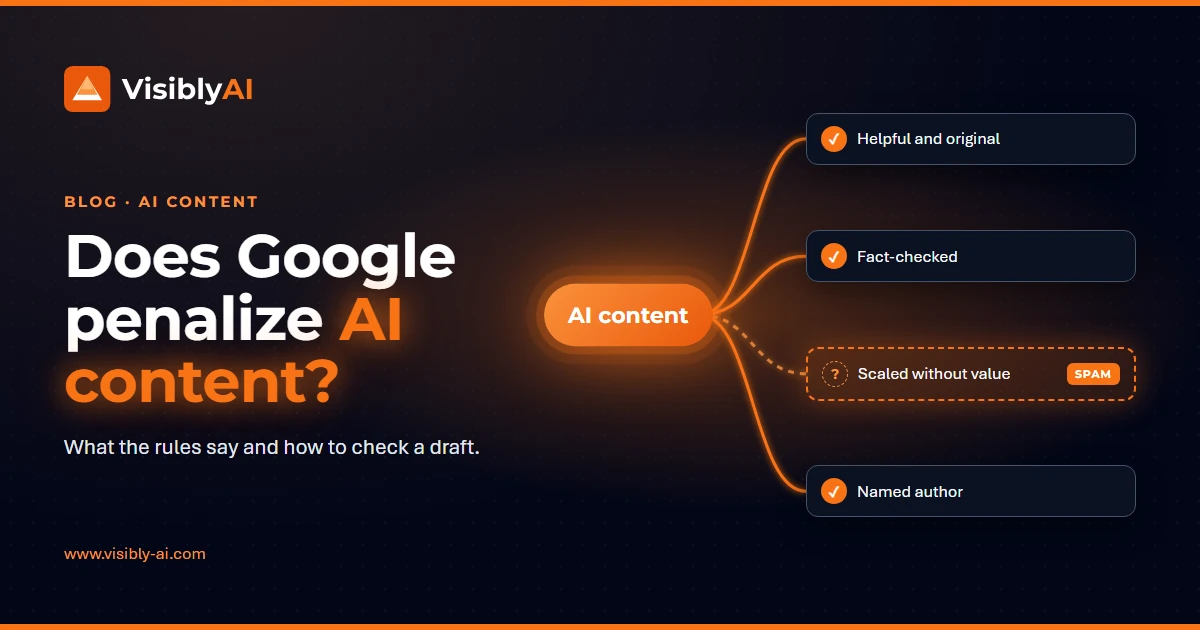
Does Google penalize AI content? What the rules say

AI summary
- Google does not penalize content because AI wrote it. Appropriate use of AI is not against its guidelines (Search Central Blog, February 8, 2023).
- What is against the spam policies is scaled content abuse: many pages generated to manipulate rankings without value for users, no matter how they are created.
- A penalty in the strict sense is a manual action with a notice in Search Console. Weak AI content usually just does not rank.
- AI detectors are unreliable: a study found they misclassified writing by non-native English speakers as AI-generated (Liang et al., arXiv, 2023).
- Own measurement: a readable AI draft scored 67 in NSS; an attributed quote, a study and own data moved it to 80.
Created with AI, the details are in the article.
Table of contents
- Does Google penalize AI content? The short answer
- What counts as a Google penalty for content quality?
- How does Google detect AI-generated content?
- Does using AI to write content hurt your SEO rankings?
- Our analysis: an AI draft in the text check
- Optimizing content before publishing: the workflow in Visibly
- What this means for you
- Frequently asked questions
In October 2026 I spoke with the team of a health platform. Their advice articles were written with AI, well structured and free of errors. They did not rank. The team asked me the question I hear in almost every first call: does Google penalize AI content?
The short answer is no. The search engine does not penalize content because artificial intelligence wrote it. It can demote or remove content that adds no value. AI makes that kind of content very cheap to produce. In this article I go through the official documentation and explain what a penalty actually is. I also show how AI detection works and how I check drafts before they go live.
Does Google penalize AI content? The short answer
No. The ranking systems judge content quality, however the content was produced. The guidance for this was published in February 2023. This is the position according to Danny Sullivan and Chris Nelson of the Search Quality team:
"Appropriate use of AI or automation is not against our guidelines. This means that it is not used to generate content primarily to manipulate search rankings, which is against our spam policies."
Search Central Blog, guidance about AI-generated content, 8 February 2023
Two things follow from that. AI-generated content is allowed. And the purpose decides. Content made to help people is fine. Content generation at scale to manipulate search rankings is spam content.
Google guidelines: what is the official policy on AI-generated content?
The policy sits in three documents. I read all three again on 12 November 2026.
| Document | What it says about AI content |
|---|---|
| Search Central Blog, February 2023 | High-quality content is rewarded "however it is produced". Using AI does not give content any special gains. |
| Spam policies, scaled content abuse (since March 2024) | Generating many pages with generative AI tools "without adding value for users" is listed as an example of abuse. |
| Guidance on using generative AI content | AI is useful for research and structure. Focus on accuracy, quality and relevance, and fact-check before publishing. |
Is AI content against Google's guidelines?
Not by itself. The spam policies name the behavior, and the tool is secondary. Scaled content abuse is defined as the case "when many pages are generated for the primary purpose of manipulating search rankings and not helping users". The policy adds: "no matter how it's created" (spam policies). A human content farm falls under the same rule on spam and manipulation as an AI one.
The Google perspective: is AI content treated differently from human-written content?
Officially, no. The 2023 guidance answers the question whether AI content will rank highly like this: "Using AI doesn't give content any special gains. It's just content." If it is useful, original and shows Google E-E-A-T (experience, expertise, authoritativeness, trustworthiness), it might do well. If not, it might not. The standard is the same for human writers and for creators who use AI for content creation.
What counts as a Google penalty for content quality?
Most people use the word penalty for two different things. It helps to separate them, because the fix is different.
| Manual action | Algorithmic demotion | |
|---|---|---|
| Who decides | A human reviewer at Google | Ranking systems and spam systems |
| How you find out | Notice in Search Console | No notice, you see falling rankings |
| Typical trigger | Violation of a spam policy | Content that systems rate as unhelpful or as spam |
| Way back | Fix the issue, file a reconsideration request | Improve the content and wait for systems to reassess |
The consequence fits in one sentence: "Sites that violate our spam policies may rank lower in results or not appear in results at all." (Search Central Blog, 5 March 2024). Most sites with weak AI content never get a manual action. They simply do not rank, like the health platform from my call.
What happens to a site's traffic after Google detects AI content?
Nothing happens because of the AI. Sometimes the spam systems classify pages as scaled content abuse. Those pages lose their search engine ranking or drop out of the index. Traffic falls with them. If the content is merely average, there is no sudden drop. The pages just never earn traffic in the first place.
Will Google deindex pages with AI-generated content?
Pages that violate spam policies can be removed, and that includes scaled content abuse. A single AI-assisted article that helps readers is not at risk. Thousands of near-identical pages built to catch keywords are.
Has Google updated its algorithm to target AI content specifically?
The policies were updated to target scale and low value. No system has been announced that targets AI as such. On 5 March 2024 the scaled content abuse policy arrived together with a core update of the Google algorithm. The new policy builds on the older rule about automatically generated content. It applies whether content is produced through automation, human efforts or a combination. The Google helpful content update of 2022 had the same goal: content created for people first. Since the helpful content update, user experience and usefulness weigh more than volume.
Is AI content penalized more than duplicate content or spun content?
Spun content and scaled AI content fall under the same policy today. The spam policies name "automated transformations like synonymizing, translating, or other obfuscation techniques" as one example. Generative AI tools are another. Duplicate content is a different case. The search engine usually picks one version to show and filters the rest. It becomes a spam question when content is scraped or copied to manipulate rankings.
Content originality: what about plagiarism?
Content originality matters more than the tool. A language model can reproduce phrasing close to its training data, so run a plagiarism check on important pages. Originality in the sense of the rater guidelines means more than unique wording. It means information, data or experience that other pages do not have.
What will change? Predictions for AI content
Nobody outside the company knows the next update. The direction since 2023 has been stable. Every rule change targeted value and scale. None targeted the tool. I plan content on that basis.
How does Google detect AI-generated content?
Artificial intelligence on the ranking side is nothing new. The Google algorithm has used machine learning for years, and natural language processing and information retrieval are its core disciplines. Still, the company does not say that it runs an AI detector over the web. It says that its systems do spam detection. In the 2023 guidance: "We have a variety of systems, including SpamBrain, that analyze patterns and signals to help us identify spam content, however it is produced."
What are the signals Google uses to identify AI-written text?
There is no published list. From the policies you can read what the systems are built to find. Many pages published at once. Little original information. Pages that repeat what already ranks. Content that makes little sense to a reader but contains search keywords. Search is information retrieval, and natural language processing helps a ranking system judge what a page says. None of these signals requires knowing whether a machine wrote the text.
Can Google detect and penalize AI-generated text?
AI detection is unreliable in general. A study by Liang and colleagues found that GPT detectors consistently misclassified writing by non-native English speakers as AI-generated. Simple prompting was enough to bypass them (arXiv, 2023). The study is a warning about algorithmic bias in detection.
Should you aim for undetectable content?
No. Tools that promise undetectable content solve the wrong problem. They change the wording and add nothing a reader needs. The useful question is whether the page gives a reader something that ten other pages do not.
Does Google differentiate between high-quality and low-quality AI content?
Yes, and that is the whole point of the policy. Quality raters are told to look at effort, originality and added value. The generative AI guidance points to the rater guidelines on "main content created with little to no effort, little to no originality, and little to no added value". Raters do not change rankings directly. Their content quality evaluation shows what the Google ranking system is supposed to reward.
What about AI content on YouTube?
YouTube belongs to the same company and has its own rule. Since March 2024, creators have to disclose realistic content made with altered or synthetic media, including generative AI (YouTube Blog, 18 March 2024). On YouTube the question is disclosure. In web search the question is value. If you embed YouTube videos or publish transcripts of YouTube videos on your site, both rules apply to you.
Does using AI to write content hurt your SEO rankings?
AI hurts search engine optimization when it replaces the parts that made your content worth ranking. The basics of search engine optimization have not changed: a page has to answer the query better than the alternatives.
Creating content with AI: three typical mistakes
- No experience: The model does not know your customers or your product. Without your own examples the text is interchangeable. More on Google E-E-A-T in the article on E-E-A-T SEO.
- No fact check: The guidance is explicit: "It is critical to manually factcheck and review all AI-generated content for accuracy and trustworthiness before publishing."
- Too much at once: Fifty new pages in a week with the same structure look like scaled content, even if each one is acceptable.
- Nobody behind it: Pages without a named author and contact details give readers no reason for trust. An author page and a way to contact the business are basic trust signals.
Does editing AI content before publishing protect you from Google penalties?
Editing helps when it adds something. Changing words does not. A case study from my own work is a beauty online shop. There, a person reviews every text before it goes live, including the ones written with AI. The steps are correction, review, comments, revision and upload. The review is where product knowledge from customer support enters the text. That knowledge is what the AI draft lacked.
Which AI content tools are safest to use for SEO purposes?
No tool is safe or unsafe by itself. The policies do not name tools. What matters is the process around the tool. You need a brief based on real search data and a style guide. You need a fact check and a named person who approves. Safe also means privacy. Read the privacy terms of a tool before you paste client data into it. I have not run a comparison test of writing tools, so I do not rank them here.
Is Bing more lenient than Google when it comes to AI-generated content?
I have no data of my own on that and I do not want to guess. My advice is to write for the stricter standard. Content that is accurate, original and useful has no reason to fear either search engine.
Our analysis: an AI draft in the text check
For this case study we analyzed our own data. The table shows the values Visibly AI® returned for the first AI draft of the German sister article. The date was 12 November 2026.
| Metric | First draft | Finding |
|---|---|---|
| Words and sentences | 2,032 words, 215 sentences | 9.5 words per sentence on average |
| Readability | 97 of 100 | Short sentences, 8 long sentences flagged |
| Style | 91 of 100 | 21 modal verbs, a share of 1.03% against a threshold of 1.0% |
| Stock phrases | 4 findings | Exactly the four phrases the article quotes as bad examples |
| NSS | 67 of 100 | Too long, three sub-questions unanswered |
Source: own measurement in Visibly AI®, 12 November 2026.
The draft read well and still scored 67. The language was fine. The gaps were in coverage, evidence and length. It took eight measuring rounds to reach 80. What moved the score most was adding an attributed quote, a study and our own data. The official guidance asks for the same things. Research on generative engines points the same way. Aggarwal and colleagues report that adding citations, quotations and statistics raised the visibility of sources in AI answers (arXiv, 2023).
Optimizing content before publishing: the workflow in Visibly
- Create the analysis: Enter the keyword. Visibly returns terms, entities and the sub-questions from the search results.
- Paste the draft: Write in the editor or paste a draft from any AI tool.
- Check the language: The text check highlights typical AI phrases, long sentences and unsupported claims in the text. Other style categories, such as passive voice and filler words, are built for German and do not yet work reliably for English.
- Check the evidence: The editor shows E-E-A-T signals of the draft: author, sources, own data, case study, quotes.
- Measure again: The NSS shows the effect of your revision. Before approval, a quality check finds AI phrasing, unsupported claims and broken links.
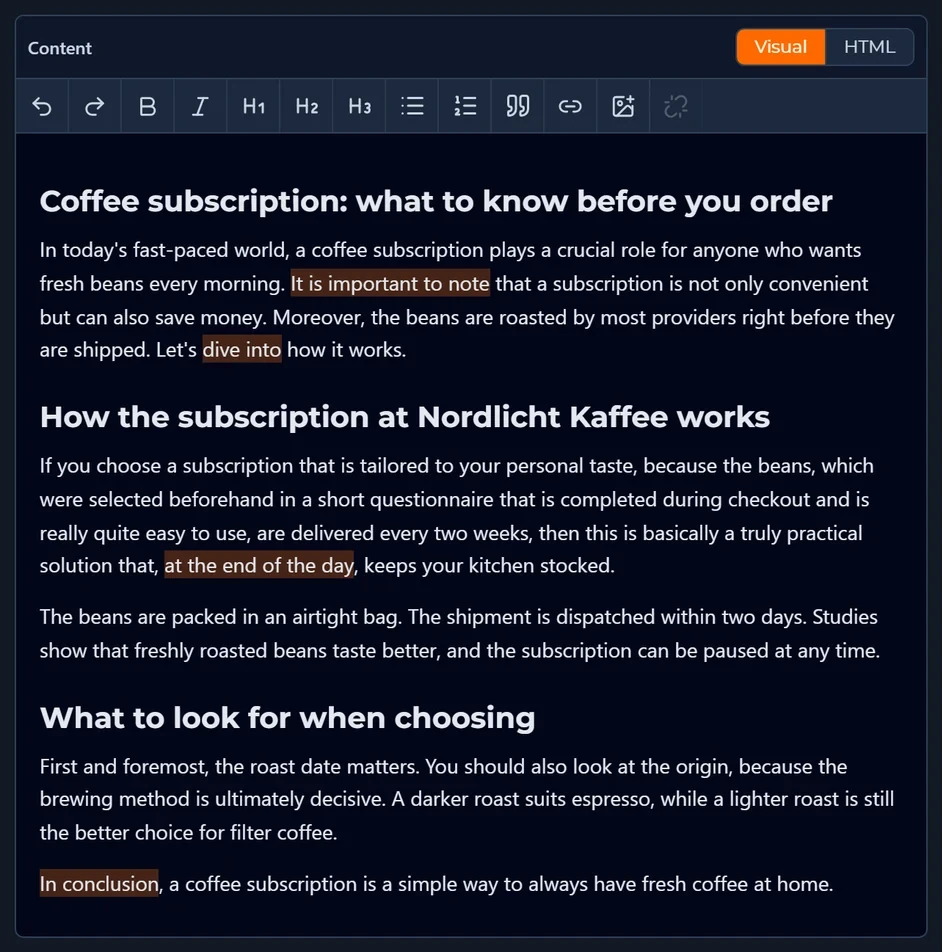
NSS is a working aid. A high score is no promise of a ranking or of a citation in AI answers. All functions are listed under Features, plans under Pricing. If you want an agent to run these steps, see Claude SEO. Approval stays with you.
What this means for you
As a small business owner, will using AI content hurt my Google rankings?
Not if you publish a few useful pages and check them. Use AI for the draft. Add your prices, your cases and your local knowledge. Have one person approve each page.
As a blogger, should I be worried about Google penalizing my AI-written posts?
Worry about sameness, and less about penalties. A post that repeats the top ten results gives nobody a reason to rank it. Your own experience is the part no tool delivers.
As an SEO professional, how should I advise clients about AI content risks?
Separate the two risks. The policy risk is scale without value. The business risk is content that ranks nowhere and costs time. I advise clients to set a review step. Publish in small batches. Each draft is measured against the search results before it goes live.
As a content marketer, how can I use AI without triggering Google penalties?
Use AI for content generation where it is strong: research, structure, first drafts, variants. Many creators stop there and publish. Keep facts, examples and the final decision with people. Say how content was made where readers would expect it. The guidance suggests giving users that context.
Content regulation: do you have to label AI content?
For web search the guidelines contain no labeling duty. The guidance only suggests giving readers context. Merchant Center and YouTube have their own disclosure rules. Laws on AI transparency differ by country. Ask a lawyer for your market. This article is not legal advice.
As an e-commerce site owner, is AI product description content safe for SEO?
It is safe when the descriptions are accurate and specific to the product. Accurate product data is part of the user experience. For Merchant Center there is an extra rule. The guidance states that AI-generated product data such as title and description attributes "must be specified separately and labeled as AI-generated".
As a freelance writer competing with AI, does Google actually reward human content?
The stated goal is to reward original, high-quality content that shows experience and expertise. Nobody is rewarded for the fact that a human typed it. Your advantage is access: interviews, tests, numbers, opinions. Put those at the top of the page.
Frequently asked questions
Will Google penalize my website for using AI-generated content?
The truth is less dramatic than many headlines. Not for using AI. The spam policies act against content made mainly to manipulate search rankings, and against many pages without value for users.
Do AI content articles rank lower in search results?
Does Google rank AI-written articles lower in search results? There is no rule that ranks AI-written articles lower. Articles without original information rank lower, whoever wrote them.
How does Google's stance on AI content compare to its stance on spun content?
Both fall under scaled content abuse when they are produced in volume without adding value. Spun content has no legitimate use. AI content does.
To see how your brand appears in ChatGPT, use the free visibility check. The basics of AI and SEO are covered on antonioblago.com.
Methodology: quotes from the Search Central Blog (8 February 2023 and 5 March 2024), the spam policies and the guidance on using generative AI content. All sources were accessed on 12 November 2026. YouTube rule from the YouTube Blog of 18 March 2024. Study on detectors: Liang et al., arXiv:2304.02819, version of 10 July 2023. Values of our own article draft measured in Visibly AI® on 12 November 2026. Search volume "does google penalize ai content": 90 per month in the United States, Visibly AI, 9 November 2026. Experience from my own conversations with clients and prospects, September to November 2026, transcripts stored locally, anonymized.
How visible is your website on Google and in AI answers? Run the free visibility check.
Check for free